
Who we cover
Restaurants, cafes, offices, retail, salons, and rental or managed properties across Wichita Falls and nearby towns.
Requests taken 24 hours a day
Wichita Falls, Texas
Need Commercial Plumbing Wichita Falls, TX you can count on? A restaurant that cannot open, a rental with a tenant waiting, or a backflow test due? Tell us what the property needs and we will connect you with a licensed plumber set up for commercial work.
No forms, one call and you are connected
Available 24/7 in Wichita Falls
(940) 278-1884 📞 Call NowCalls are answered around the clock and may be recorded for quality and routing. Standard call rates apply.
Quick Answer
The commercial plumbing Wichita Falls, TX businesses rely on covers restaurants, offices, retail units, and rental properties, grease line jetting, backflow testing and certification, water heater and boiler work, fixture installs, and scheduled preventive maintenance. Commercial work carries code requirements, health-inspection deadlines, and downtime costs a home never does, so it is routed to a plumber set up for it. Verify the license at the Texas State Board of Plumbing Examiners. For commercial work, call (940) 278-1884.
Related reading: What a plumber costs in Wichita Falls
Restaurants, cafes, offices, retail, salons, and rental or managed properties across Wichita Falls and nearby towns.
Annual backflow testing and certification, plus grease-line jetting to keep kitchens open and passing inspection.
Commercial jobs are scheduled around your opening hours and inspection dates, say the deadline when you request.
Who This Is For
Different property types have genuinely different plumbing problems. What they share is that downtime costs money, which changes how the work should be planned.
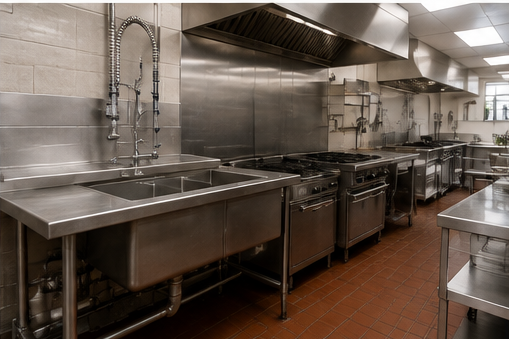
Grease lines, grease traps, floor drains, three compartment sinks and commercial water heating. The highest maintenance category and the one where a backup closes you.
Restroom fixtures, water heaters, supply lines and backflow devices. Lower intensity, but a failed restroom in a customer facing space is not a small problem.
Single family rentals, duplexes and apartment blocks. Repeat work, tenant coordination, and a real premium on getting it right the first visit.
Higher water use than a typical office, specialised fixtures, and in medical settings additional requirements around backflow and waste.
Long periods of low use punctuated by heavy demand, which is hard on systems and tends to reveal problems at the worst moment.
Backflow prevention, yard hydrants, break room facilities and larger diameter supply, often in older buildings.
The Real Difference
People assume commercial plumbing is residential work at a larger scale. Some of it is, but three things genuinely change, and they change how you should approach the work.
Say This When You Call
It routes to a different set of plumbers. Saying it up front avoids a wasted visit from someone not set up for the work.
Opening at eleven, tenant moving in Friday, inspection Tuesday. The deadline changes how the job is scheduled and it is the most useful thing you can give.
Who lets them in, when the building is empty, whether there is an alarm code. Access is the most common cause of a wasted commercial call out.
If the same line has been cleared three times, say so. It changes the diagnosis completely and stops you paying for a fourth temporary fix.
Planned Work Beats Emergencies
Nearly every expensive commercial plumbing emergency was a predictable maintenance item first. These are the ones worth putting on a calendar.
| Item | Typical interval | What happens if you wait for failure |
|---|---|---|
| Kitchen line jetting | Every three to six months, depending on volume and menu | A backup during service, a closed kitchen and an emergency rate |
| Grease trap pumping | On a set schedule based on size and throughput | Overflow, odour, and a compliance problem as well as a plumbing one |
| Backflow testing | Periodically as required, by a certified tester | A compliance failure, and a genuine public health risk if the device has failed |
| Water heater service | Annually, more often given local hard water | No hot water on a trading day, and a shorter life from a commercial unit |
| Camera survey of mains | Every few years, or when problems repeat | Repeated clearings that never address the actual defect in the line |
| Fixture and valve check | Annually across restrooms | Running toilets and dripping valves quietly inflating the water bill for months |
Questions
Higher usage volumes, larger pipe sizing, additional code requirements such as backflow prevention and grease interception, and above all a completely different cost of failure. A blocked drain at home is an inconvenience you work around. In a restaurant it closes the kitchen, and the lost trade usually exceeds the repair several times over. That difference is why preventive maintenance that would be excessive in a house is straightforwardly good economics in a commercial building.
A backflow preventer is a device that stops water flowing backwards out of your premises into the public supply, which protects everyone else on the network. Commercial properties with irrigation systems, boilers, fire suppression or certain equipment generally require one. Because it is a mechanical device it can fail, so it has to be tested periodically by a certified tester and the result filed. If you are not sure whether your building has one or when it was last tested, that is worth establishing before someone tells you it is overdue.
Most kitchens are best on a fixed schedule rather than waiting for a backup, commonly every three to six months, with frying heavy operations at the shorter end. Grease traps have their own pumping interval based on size and throughput. The economics are not close: a planned jetting outside service hours costs a fraction of an emergency call during dinner, and it does not risk a night of lost trade or a conversation with a health inspector.
For planned work, usually yes, and for most commercial premises it is the sensible arrangement. Early mornings, evenings and closed days all work for scheduled maintenance. Say so when you make the request along with your access arrangements, so it goes to a plumber who schedules that way rather than one who only works daytimes. Emergencies are a different matter, since those happen when they happen.
It depends entirely on the lease, and it is far better to know before something breaks than to work it out while water is on the floor. Commonly the landlord is responsible for building systems such as the main supply, drainage and water heating, while the tenant covers fixtures and equipment they installed. But commercial leases vary widely and some push almost everything onto the tenant. Read the wording, and if it is ambiguous, get it clarified in writing while nothing is urgent.
Yes. Apartment blocks, duplexes and single family rentals across Wichita Falls all come up regularly, including repeat maintenance and turnover work between tenants. If you manage several properties it is worth mentioning, because some plumbers prefer that kind of ongoing arrangement and will price and schedule it differently from one off call outs. Tenant coordination is also something worth raising up front, since access is the usual bottleneck.
Older buildings in the downtown area carry the same issues as older housing stock, often more so: cast iron drain lines that have scaled and corroded, galvanized supply, and systems that have been extended repeatedly over decades without a coherent plan. A camera survey of the main lines is genuinely worthwhile in these buildings, because it turns an unknown into a maintenance plan and it usually explains problems that have been recurring for years.
Related
For grease packed kitchen lines and root filled sewers that a cable will not fix.
Burst pipes, sewer backups and water heater failures, 24 hours a day.
Ranges, outdoor kitchens, pool heaters and generators, pressure tested and permitted.
Tell us the deadline when you make the request. Commercial work is routed differently because the clock matters.