
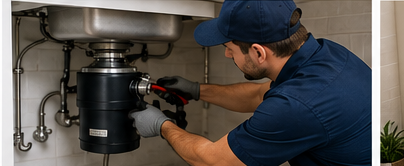
Humming, not turning
Jammed flywheel. Cut power, turn the hex key in the bottom socket to free it, then press reset. Never use your hand.
Requests taken 24 hours a day
Wichita Falls, Texas
Need Garbage Disposal Repair Wichita Falls, TX you can count on? Humming but not turning, jammed solid, leaking under the sink, or completely dead? Tell us what it is doing and we will connect you with a licensed plumber nearby.
No forms, one call and you are connected
Available 24/7 in Wichita Falls
(940) 278-1884 📞 Call NowCalls are answered around the clock and may be recorded for quality and routing. Standard call rates apply.
Quick Answer
The garbage disposal repair Wichita Falls, TX homeowners need is often simple: a unit that only hums is usually jammed, cut the power and free the flywheel with the hex key from the bottom, and a dead unit often just needs the reset button. Leaks decide the outcome: a leak at the sink flange can be resealed, but a leak from the unit body means replacement. A licensed plumber checks the wiring and trap too. Verify the license at the Texas State Board of Plumbing Examiners. For disposal help, call (940) 278-1884.
Related reading: How to unclog a toilet
Jammed flywheel. Cut power, turn the hex key in the bottom socket to free it, then press reset. Never use your hand.
Press the red reset button underneath first. If it trips again immediately, the motor or wiring needs a plumber.
A flange leak reseals; a leak from the body means the unit is done and replacement is the honest call.
Before You Call Anyone
A large share of disposal call outs are resolved by two things the homeowner can do in five minutes. Both are safe if you follow the order.
What the Symptom Means
Jammed. Motor has power, plate cannot rotate. Hex key clears it. Leaving it humming burns the motor out, so switch it off.
Reset button first, then the breaker. If both are fine, the motor or switch has failed.
Usually broken or worn impellers, or a snapped drive coupling. Generally replacement territory.
Stop using it and switch it off at the breaker. The motor is failing and continuing to run it is a genuine risk.
Leaks
A leaking disposal is either a cheap fix or a replacement, and the difference is entirely about which part the water comes from. Dry everything, run it, and watch.
| Where the water appears | What it means | Repair or replace |
|---|---|---|
| Top, at the sink flange | The mounting seal or plumber's putty has failed | Repair. The unit is dropped, resealed and remounted |
| Side inlet | Dishwasher hose connection or its clamp | Repair. Often just a hose or clamp |
| Discharge pipe | The gasket or bolts at the outlet elbow | Repair. Inexpensive parts |
| Bottom of the unit itself | Internal seal has failed and water is passing the motor housing | Replace. This is not sealable from outside |
| Reset button area | Same as above, water tracking down the body | Replace, and switch it off at the breaker meanwhile |
If water is coming from the body of the unit, stop using it and cut power at the breaker. Water and a live motor housing is the one scenario here worth treating as urgent.
Local Note
It grinds waste smaller, but everything still has to travel the same pipe. In most homes here that pipe runs under a slab, which is the coolest part of the run.
Nothing a disposal does stops fat cooling and setting further down the line. Grease belongs in a can and then the bin, disposal or not.
Cold keeps fats solid so they get ground and carried rather than melting and coating the pipe wall downstream. Hot water does the opposite.
The same mineral load that affects everything else builds up inside the grinding chamber and around the seals, which shortens unit life here.
In Faith Village, Country Club and Floral Heights the kitchen line is often cast iron that has already scaled and narrowed. Adding ground food to that is asking a lot of it.
If your kitchen drain blocks regularly, the disposal is not the fault but it may be making it easier to reach. That line probably needs jetting rather than another cabling.
Questions
It is jammed. The motor is receiving power but the grinding plate cannot rotate, which is what produces the hum. Switch it off at the wall first, then find the hex socket in the centre of the underside and use the hex key to work the plate back and forth until it turns freely. Press the reset button afterwards, since the overload will almost certainly have tripped. Do not leave it humming while you work this out, because that is how the motor burns out, and never put your hand inside even with the power off.
Start with the reset button on the underside of the unit, usually red. It trips on overload and leaves the disposal appearing completely dead, and pressing it resolves a genuinely large share of call outs. If that does nothing, check the breaker in your panel. If the reset is in, the breaker is on and it still does nothing at all, then the motor or the wall switch has failed and it needs looking at properly.
Maybe, and where it comes from decides whether this is cheap or not. Dry everything thoroughly, run the disposal, and watch closely. Water at the top where it meets the sink means the mounting seal has failed, which is repairable. Water at the side inlet is usually the dishwasher hose or its clamp. Water at the discharge pipe is a gasket. But water coming from the bottom of the unit itself means an internal seal has gone, and that cannot be fixed from outside. That one is a replacement.
Cooking grease and oil above everything else, because a disposal does nothing to stop fat cooling and setting further down the line, and in most Wichita Falls homes that line runs under a slab. Beyond grease: fibrous vegetables like celery and artichoke, potato peel which turns to paste, rice and pasta which swell, coffee grounds, bones, fruit pits and eggshell membranes. The principle is simple. A disposal grinds waste smaller, it does not change what your drain can actually carry away.
Jams, tripped resets and connection leaks are all worth fixing and usually quick. Replacement makes more sense when there is a leak from the body of the unit, a burning smell, or a motor that will not run even after resetting and clearing. The reasoning is practical rather than technical: the labour to diagnose a failed motor and source internal parts gets close to the cost of a new unit, and the new unit comes with a warranty.
Not directly, but it makes the conditions easier to create. It encourages putting food waste into a drain that then has to carry it, and in most homes here that drain runs under a concrete slab where things cool and settle. If your kitchen line blocks repeatedly, the disposal is not the fault, but the habits it enables may be contributing. In that situation the line usually needs jetting rather than another cabling, because the problem is coating rather than one obstruction.
Run cold water before, during and for a good few seconds after use, so ground waste is carried well clear rather than settling in the trap. Cold matters specifically because it keeps fats solid enough to be ground and carried instead of melting and coating the pipe downstream. Feed waste in gradually rather than filling the chamber and switching on. Grinding ice cubes occasionally helps clear buildup. And do not use chemical drain cleaners in it, which damage the seals.
It is one of the more approachable kitchen jobs if the replacement uses the same mounting system, since many brands share a standard fitting. The things that catch people out are the electrical connection, which needs doing correctly and to code, and the dishwasher inlet knockout plug, which has to be removed on a new unit or the dishwasher will not drain. If the new unit uses a different mounting or the wiring is not straightforward, it is worth having a plumber do it.
Related
Slow tubs, blocked kitchen lines and sewer clogs, cleared and camera checked.
Dripping taps, tub valves, hose bibs and shower cartridges.
Running, blocked, rocking or leaking at the base, repaired or replaced.
Try the reset button and the hex key first. If neither works, tell us what it is doing and we will get someone to look at it.