
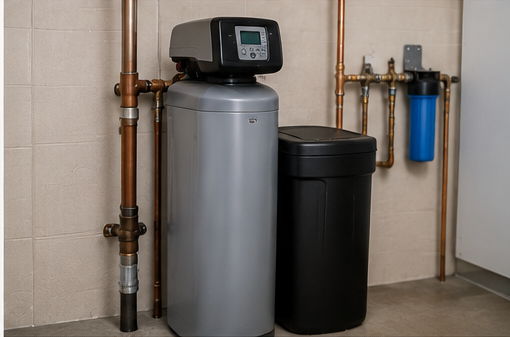
Signs you need one
White scale on glasses and shower screens, soap that will not lather, stiff laundry, and a water heater that rumbles.
Requests taken 24 hours a day
Wichita Falls, Texas
Need Water Softener Installation Wichita Falls, TX you can count on? Scale on the shower screen, spots on every glass, and a water heater that rumbles? That is our water. Tell us about your household and we will connect you with a licensed plumber who fits softeners here.
No forms, one call and you are connected
Available 24/7 in Wichita Falls
(940) 278-1884 📞 Call NowCalls are answered around the clock and may be recorded for quality and routing. Standard call rates apply.
Quick Answer
Water softener installation Wichita Falls, TX is worth it because our water is genuinely hard, it leaves scale that shortens water heater life, spots glassware, stiffens laundry, and clogs fixtures and shower heads. A softener removes the calcium and magnesium before they reach your pipes and appliances, protecting everything downstream. A licensed plumber sizes the unit to your household and handles the drain and bypass connections. Verify the license at the Texas State Board of Plumbing Examiners. To size a softener, call (940) 278-1884.
Related reading: Why Wichita Falls water is so hard
White scale on glasses and shower screens, soap that will not lather, stiff laundry, and a water heater that rumbles.
Water heater, dishwasher, washing machine, faucets, and shower heads all last longer on softened water.
Salt-based ion exchange truly softens; salt-free only conditions scale. A plumber advises which fits your water.
The Local Problem
In a city with soft water, softeners are a niche product. In Wichita Falls they solve the single most expensive recurring plumbing problem homeowners here face.
The city draws from surface reservoirs and the supply carries a heavy mineral load. Those minerals stay dissolved while the water is cold and moving. Heat it or let it sit, and they come out of solution and stick to whatever they are touching.
Signs You Have It
Chalky deposits that come back a week after cleaning. That is calcium, and what you can see on the outside is also forming inside the pipe and the heater.
Popping or rumbling during heating is water boiling underneath a sediment layer on the tank floor. It is the clearest sign scale is already costing you.
Using noticeably more shampoo, detergent and dish soap than seems reasonable is a hardness symptom, not a product problem.
Choosing One
There is a lot of marketing in this category. Here is what the main types actually do, including where the claims get thin.
| Type | What it genuinely does | Worth knowing |
|---|---|---|
| Ion exchange softener | Actually removes hardness minerals by swapping them for sodium or potassium. The proven approach | Needs salt topped up, a drain for regeneration and a power outlet. This is what most people mean by a softener |
| Salt free conditioner | Changes how minerals crystallise so they are less likely to stick, which reduces scale buildup | It does not remove hardness. Water is still hard by measurement, so soap lathering and spotting do not improve much |
| Dual tank softener | Same as ion exchange but one tank stays in service while the other regenerates | Useful for large households with heavy overnight use. Overkill for a typical family, and it costs more |
| Magnetic or electronic descaler | Claims to alter mineral behaviour with a field applied to the pipe | Evidence for these is weak and inconsistent. Be sceptical of strong claims and ask for measurable results |
| Softener plus filtration | Softening combined with sediment or carbon filtration for taste and chlorine | Sensible combination here, but they are separate jobs solving separate problems. Do not let one be sold as the other |
Sizing matters as much as type. It depends on household size and how hard the incoming water is, and an undersized unit regenerates constantly while an oversized one wastes salt. Ask what your plumber sized it on.
The Install
The incoming water is tested for hardness and the unit sized against that and your household's daily use. This is the step that decides whether the softener performs, and it should happen before any model is recommended.
The unit goes on the main line where water enters the house, so everything downstream is treated. It needs a drain for regeneration discharge and a power outlet, which in most Wichita Falls homes means the garage or a utility area near the heater.
A bypass valve is fitted so the softener can be taken out of circuit for service without cutting water to the house. The unit is programmed, the brine tank charged and the first regeneration run and checked.
Questions
Yes. The city draws from surface reservoirs and the supply carries a heavy mineral load, which is why this is a service worth a page of its own here. You see the evidence daily: white scale on shower screens and taps that returns within a week of cleaning, spotting on glassware, soap and detergent that will not lather properly, and a water heater that rumbles as sediment builds on the tank floor. If you want a number for your specific address, a plumber can test it, and the city publishes water quality reports.
A conventional softener runs your water through resin beads that swap the calcium and magnesium causing the hardness for a small amount of sodium or potassium. Periodically the unit flushes those beads with a brine solution to recharge them and sends the waste to a drain, which is the regeneration cycle you occasionally hear running, usually programmed for overnight. That is the whole principle, and it is well established rather than novel.
In this city, genuinely yes, which is not something worth saying about every plumbing upsell. Scale is the main reason water heaters here fall short of their rated life, and the same scale affects fixtures, valves, dishwashers and washing machines. The best time to fit one is alongside a new water heater rather than after the old one has failed early, because then you are protecting the new investment from day one instead of starting the clock again.
On the main line where water enters the house, so that everything downstream of it is treated. It needs three things nearby: the main line itself, a drain to take the regeneration discharge, and a power outlet. In most Wichita Falls homes that combination points at the garage or a utility area near the water heater. If none of those are together, the install gets more involved, which is worth establishing before you get a price.
No. The amount of sodium added is small and nowhere near a salty taste. Softened water does feel noticeably different, particularly in the shower where it feels slippery and soap seems harder to rinse off, and that is the softener working rather than a fault. Some people love it immediately and others take a few weeks. Many households have the kitchen cold tap left unsoftened for drinking and cooking, which is a simple thing to specify at install time.
Mainly keeping the brine tank topped up with salt, which is a bag every few weeks to a couple of months depending on use and unit size. Check occasionally for a salt bridge, a hard crust that forms across the tank and leaves an air gap so the salt never reaches the water. If your water suddenly seems hard again and the tank looks full, a bridge is the usual explanation. Beyond that, a service every few years keeps the control valve and resin performing.
No, and this is worth being clear about. A softener prevents new scale forming, it does not remove what has already built up inside the tank. If your heater already rumbles heavily and has lost capacity, the damage is done. A flush may help a little, but the honest position is that a softener protects the next heater rather than saving the current one. That is exactly why fitting the two together makes sense.
Fitting a softener means cutting into the main supply line, adding a bypass, connecting a drain with the correct air gap and making sure there is no cross connection back into the supply. That last point is why it is worth a licensed plumber rather than a weekend. Done badly, a drain connection without a proper air gap can allow contamination back into your water. It is not the most complex plumbing job, but it is one where the failure mode affects what you drink.
Related
Hard water kills heaters early here. Repair, flush or replace, tank and tankless.
Galvanized and polybutylene replaced in PEX, fixed price and a written schedule.
Running, blocked, rocking or leaking at the base, repaired or replaced.
A softener is one of the few plumbing purchases that pays you back, because it extends the life of everything downstream of it.