
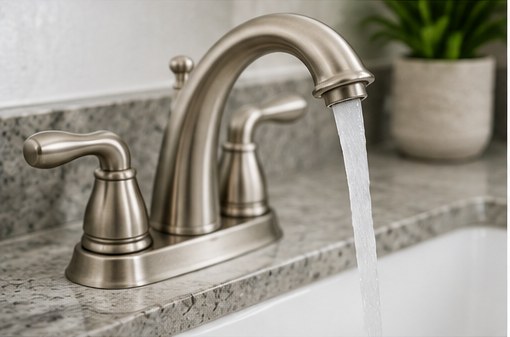
Why taps drip here
Hard water scale wears the cartridge, washer, or valve seat. A new cartridge usually fixes a persistent drip.
Requests taken 24 hours a day
Wichita Falls, Texas
Need Faucet Repair Wichita Falls, TX you can count on? A tap that will not stop dripping, a shower valve that has seized, or pressure that has faded at one sink. Tell us which fixture and we will connect you with a licensed plumber nearby.
No forms, one call and you are connected
Available 24/7 in Wichita Falls
(940) 278-1884 📞 Call NowCalls are answered around the clock and may be recorded for quality and routing. Standard call rates apply.
Quick Answer
The faucet repair Wichita Falls, TX homeowners rely on covers dripping taps, weak or fading water pressure, seized shower and tub valves, leaking spouts, and worn cartridges and washers. Much of it traces to hard water, which corrodes valve seats and clogs aerators with scale. A licensed plumber repairs or replaces the fixture and can fit a softener to slow the next failure. Verify the license at the Texas State Board of Plumbing Examiners. For faucet help, call (940) 278-1884.
Related reading: Why Wichita Falls water is so hard
Hard water scale wears the cartridge, washer, or valve seat. A new cartridge usually fixes a persistent drip.
Often a scaled-up aerator or cartridge, not a whole-house issue. Cleaning or swapping the part restores flow.
Even a dripping tap gets an itemized quote before work, no surprise charges once it is apart.
Common Faults
Fixtures fail in predictable ways, and in this city most of them trace back to the same cause. Knowing which one you have tells you whether it is a five minute job or a real repair.
The cartridge, washer or ceramic disc has worn or scaled and no longer seals. Usually a cartridge replacement rather than a new tap, provided the body is sound.
Nearly always a clogged aerator, the small screen at the outlet. Our water fills it with mineral grit. Unscrew, rinse, refit. The easiest fix in plumbing.
Scale inside the cartridge. Forcing it breaks something more expensive. Replacement restores it, though discontinued models make finding the part the hard part.
Worn O rings where the spout swivels, common on kitchen mixers. Inexpensive parts, but it needs the right kit for that model.
Stripped splines on the cartridge stem or a failed handle adaptor. Sometimes just the handle, sometimes the whole cartridge.
The most common freeze casualty here. If it leaks inside the wall rather than at the spout, the pipe behind has split and the wall needs opening.
Going cold when a toilet flushes points at a failed pressure balancing cartridge, which is a safety part as much as a comfort one.
A misadjusted or corroded lift rod linkage under the basin. Fiddly rather than difficult, and often adjustable rather than needing parts.
The Common Cause
If you have lived somewhere with soft water, fixtures here fail noticeably sooner and you have probably wondered why. It is not the fittings being worse. It is what is in the water.
Wichita Falls draws from surface reservoirs and the supply carries a heavy mineral load. Every fixture in the house has water sitting against its sealing surfaces permanently, and minerals deposit on exactly the surfaces that need to stay smooth to seal.
The practical implication is that fixture parts here need replacing on a shorter cycle than the packaging suggests, and that a softener protects fixtures as well as your water heater.
Get Connected With a PlumberWorth Trying Yourself
Unscrew the tip of the tap, rinse the screen, soak it in vinegar if it is crusted, and refit. If pressure was only bad at that one tap, this often fully solves it.
Same principle. A bag of vinegar tied over it overnight clears blocked jets and restores a pattern that has gone patchy.
Before touching any fixture, locate the small valve under the sink or behind the toilet and check it actually turns. Discovering a seized shutoff mid job is how a small task becomes an emergency.
Questions
The part inside that does the sealing, which is a cartridge, washer or pair of ceramic discs depending on the design, has worn or scaled to the point where it no longer closes cleanly. In hard water areas like ours, mineral deposits build up on exactly those sealing faces, so this happens sooner here than the manufacturer expects. The fix is usually a cartridge replacement rather than a whole new tap, provided the body itself is in good condition.
Almost always the aerator, which is the small removable screen at the outlet. Our water carries enough mineral content to fill it with grit over time, and because it only affects that one outlet people assume something more serious. Unscrew it, rinse the screen out, soak it in vinegar if it is properly crusted, and refit it. It is the single easiest fix in plumbing and it costs nothing. If pressure is low at every tap, that is a different problem worth investigating.
Scale building up inside the cartridge, which is extremely common here. The important thing is not to force it, because a stuck cartridge usually gives way by breaking the handle, the stem or occasionally the valve body, and each of those turns a modest repair into a significantly bigger one. A cartridge replacement restores normal operation. The genuine difficulty is that older or discontinued valves can be hard to source parts for, so identifying the brand early helps.
Yes, though not urgently. A steady drip wastes a meaningful volume over a year, and if it is the hot tap you are paying to heat that water as well as buy it. It also leaves mineral staining on the fixture and the basin that eventually will not clean off. The sensible approach is to bundle it with any other plumbing visit rather than either ignoring it for years or calling someone out specifically for one tap.
Repair if the body is sound and parts are available, which covers most cases and is usually the cheaper route. Replace if the body itself is corroded, the finish has failed and looks poor, the model is discontinued with no cartridge obtainable, or you were planning to change the look anyway. Worth knowing: the labour is broadly similar either way, so the part cost is usually what decides it. If a plumber is already there for something else, that tips it further toward doing it properly.
Hose bibs are the most common freeze casualty in North Texas, because they sit in the coldest position with a hose often still attached holding water in them. The critical question is where it leaks. If water appears at the spout only when the tap is on, that is usually a repairable valve. If it leaks inside the wall, or you see damp inside near that wall, the pipe behind the bib has split and the wall needs opening. Shut the water off and get that looked at rather than leaving it.
Plenty of people do, and on a modern installation with working shutoffs and reasonable access it is achievable. The parts that go wrong are the ones you cannot see in advance: a shutoff valve that will not close or will not reseal afterwards, corroded supply connections that shear off, and access under a deep basin that turns out to be far tighter than expected. If the shutoff does not turn cleanly, stop there, because that is the point where a small job becomes a flooded cabinet.
The pressure balancing cartridge in the shower valve is not compensating as it should. When a toilet fills it draws cold water, the balance shifts, and a working valve adjusts to keep your temperature steady. When it fails you get a sudden temperature swing, which is a scalding risk as well as unpleasant. It is a cartridge replacement, and it is worth treating as a safety item rather than an annoyance, particularly with children or elderly people in the house.
Related
Running, blocked, rocking or leaking at the base, repaired or replaced.
Jammed, humming, leaking or dead, repaired or swapped out.
Galvanized and polybutylene replaced in PEX, fixed price and a written schedule.
A dripping tap is not urgent, but it is not free either. Get it quoted properly rather than living with it.