
Repair or repipe?
One leak is a repair. Repeat leaks in different spots, rusty water, and fading pressure mean the pipe itself is failing.
Requests taken 24 hours a day
Wichita Falls, Texas
Need Repiping Wichita Falls, TX you can count on? Patching a leak every few months, or rusty water on the first draw? At some point the pipe itself is the problem. Tell us what your house is doing and we will connect you with a licensed plumber who repipes here.
No forms, one call and you are connected
Available 24/7 in Wichita Falls
(940) 308-0202 📞 Call NowCalls are answered around the clock and may be recorded for quality and routing. Standard call rates apply.
Quick Answer
The repiping Wichita Falls, TX homeowners choose replaces failing supply lines throughout the house, usually when you are patching a leak every few months, seeing rusty water on the first draw, or losing pressure across multiple fixtures. Older local homes still run galvanized steel and, in some eras, polybutylene, both past their service life. A repipe in PEX or copper comes with a fixed price and a written schedule. Verify the plumber's license at the Texas State Board of Plumbing Examiners. To get a repipe quote, call (940) 308-0202.
Related reading: What a plumber costs in Wichita Falls
One leak is a repair. Repeat leaks in different spots, rusty water, and fading pressure mean the pipe itself is failing.
PEX installs faster, tolerates freezes, and costs less; copper lasts longer in exposed runs. A plumber advises per home.
A proper repipe quote is a fixed price with a written schedule, not an hourly job that drifts once the walls are open.
The Decision
Almost nobody repipes a house on the first leak, and almost everybody wishes they had stopped repairing sooner than they did. Here is roughly where the line sits.
| What you are seeing | Still a repair | Time to consider a repipe |
|---|---|---|
| Leak history | First leak, or the same joint twice | Third leak, in three different places |
| Water colour | Clear, or briefly cloudy after work on the line | Rusty or brown on first draw, especially from several taps |
| Pressure | Dropped suddenly, pointing at one fault | Fallen gradually over years across the whole house |
| Pipe material | Copper or PEX in good condition | Galvanized steel, or polybutylene of any age |
| Visible pipe | Clean joints where you can see them | Green or white corrosion, flaking, weeping at fittings |
| Under the slab | One located slab leak in sound pipe | Second slab leak, or pipe the plumber describes as thin |
A useful test: add up what you have spent on plumbing call outs in the last three years. If it is a meaningful fraction of a repipe quote, you are already paying for one in instalments without getting the benefit.
Know What You Have
You can usually identify your supply pipe by looking at the exposed run near the water heater or under a sink. What you find says a lot about what to expect.
Grey, threaded at the joints, and magnetic. Common in homes built before the 1960s, so plenty of it survives in Floral Heights and the older parts of town.
The issue: it rusts from the inside. The bore narrows over decades until pressure drops, and rust colours the water. It has no remaining service life anywhere in Wichita Falls. Replacement, not repair.
Grey, flexible plastic, often stamped PB2110, usually with plastic or crimped metal fittings. Used from the late 1970s into the mid 1990s.
The issue: a poor reliability record, and it tends to fail suddenly at the fittings rather than warning you first. If you have it, plan the replacement rather than waiting for the failure.
Reddish brown, rigid, soldered joints. The standard for decades and still a perfectly good material.
The issue: our hard water works on it from the inside over a long period, and under a slab it also takes soil movement from outside. Copper that has produced two slab leaks is usually telling you something.
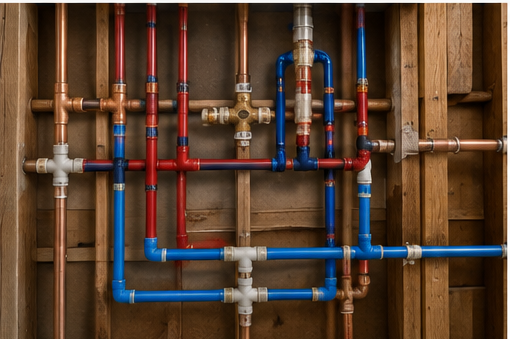
Flexible plastic, commonly red and blue for hot and cold, with crimped or expansion fittings. Standard in newer construction and most repipes.
The issue: few, in practice. It tolerates freezing better than rigid pipe because it can expand slightly, which matters in North Texas. Keep it out of direct sunlight, which degrades it.
Cream or tan rigid plastic with solvent welded joints. Seen in some builds from the 1980s onward.
The issue: it becomes brittle with age and can crack, particularly at joints and where it has been stressed. Not automatically a problem, but worth watching in an older installation.
Extremely common in homes that have been added to or partially repaired over the years.
The issue: the system is only as reliable as its worst section, and dissimilar metals joined without the right fitting corrode at the connection. A mixed system is often the strongest argument for doing the whole house at once.
The Job Itself
It is disruptive but finite, and knowing the sequence makes it far easier to plan around. A typical single storey Wichita Falls home runs roughly like this.
Get These in Writing
A repipe is a defined scope of work. It should carry a fixed quote, with any conditions that would change it spelled out beforehand.
Ask explicitly whether patching, texturing and painting are included, and to what standard. Assumptions here cost people real money.
How many days, and how many hours per day without water. If someone in the house needs reliable water, say so before the start date.
Get the length and what it covers in writing. Manufacturers warrant PEX for a long period, but that means nothing without labour cover from the installer.
Questions
The clearest signal is repeat leaks in different places, rather than the same spot failing twice. One joint failing twice is a bad repair. Three leaks in three locations is the system telling you its remaining life is short. Add rusty or brown water on the first draw, pressure that has fallen gradually over years across the whole house, and visible corrosion at exposed joints. Any one of those alone can be a local fault. Two or three together point at the pipe itself.
PEX is the usual choice now, for good reasons. It is flexible, so it needs far fewer joints and every joint is a potential future leak, and it can often be routed through existing wall cavities with less demolition. It also tolerates freezing better than rigid pipe because it can expand slightly, which genuinely matters given how North Texas freezes behave. Copper is still used, lasts well and some people prefer it, but it costs more in both material and labour.
For a typical single storey Wichita Falls home, the pipework is commonly two to four days, with drywall repair and painting afterwards. Larger or two storey homes take longer. Water is usually shut off for part of each working day rather than the entire period, so most people stay in the house throughout. Ask for the schedule in writing before agreeing, including how many hours per day you will be without water.
Yes, in places. There is no way to replace supply lines without access at the fixtures and at points along the runs. PEX reduces how much because it flexes through cavities where rigid pipe would need a straight open path, but there will be patching afterwards. The important thing is agreeing before work starts whether drywall repair, texturing and painting are included in the quote or left to you, because that is where most post job disagreements come from.
It has a poor reliability record and it tends to fail suddenly at the fittings rather than giving you warning. It was installed widely from the late 1970s into the mid 1990s, so plenty of Wichita Falls homes from that era have it. Look for grey flexible plastic, often stamped PB2110, with plastic or crimped metal fittings. If you find it, replacement is generally recommended as planned work rather than waiting for a failure to make the decision for you.
Yes. Repiping is regulated work in Texas, it requires a Responsible Master Plumber licence, and it needs a City of Wichita Falls permit with an inspection. The licensed plumber pulls the permit, not you. A contractor offering to skip it to save money is offering to leave you with unpermitted plumbing that surfaces during inspection when you sell, and that can affect an insurance claim in the meantime. It is not a corner worth cutting.
Sometimes, and it can be the right call when one section is clearly worse or when budget makes the whole job impossible right now. The catch is that access is most of the cost, so doing it in two phases usually costs more in total than doing it once. It also leaves you with a mixed system, and dissimilar materials joined without the right fittings corrode at the connection. If you do phase it, get the full plan agreed up front so phase two is not an improvisation.
No, and it is worth being clear about that. New pipe does not change the water going through it. Wichita Falls water carries a heavy mineral load either way, and that will keep affecting your water heater, fixtures and appliances. A repipe is often the right moment to add a softener, since the plumber is already working on the system and the incremental cost of doing both at once is lower than doing them separately.
Related
Warm floors and a jumped water bill. Located properly before any concrete is cut.
Acoustic and thermal detection to find the leak before anything gets opened up.
Hard water kills heaters early here. Repair, flush or replace, tank and tankless.
If you are calling someone out every few months, you are already paying for a repipe. You are just not getting one.