
The warning signs
A warm patch underfoot, running-water sound with taps off, unexplained high water bill, or cracks and damp spots in the flooring.
Requests taken 24 hours a day
Wichita Falls, Texas
A warm patch on the floor, water running when everything is off, or a bill that doubled for no reason? Get the slab leak repair Wichita Falls, TX homeowners trust, tell us what you are seeing and we will connect you with a licensed plumber who handles slab leaks here.
No forms, one call and you are connected
Available 24/7 in Wichita Falls
(940) 308-0202 📞 Call NowCalls are answered around the clock and may be recorded for quality and routing. Standard call rates apply.
Quick Answer
Slab leak repair Wichita Falls, TX homeowners need starts with detection: a warm spot on the floor, the sound of running water when every tap is off, or a water bill that jumped signals a leak in the supply lines under your concrete slab. A licensed plumber uses acoustic and thermal equipment to pinpoint it before any concrete is cut, then chooses a spot repair, a reroute, or a repipe. Verify the plumber's license free at the Texas State Board of Plumbing Examiners. To locate a slab leak now, call (940) 308-0202.
Related reading: Why your water bill is suddenly high
A warm patch underfoot, running-water sound with taps off, unexplained high water bill, or cracks and damp spots in the flooring.
Shut off every fixture and watch the water meter dial. If it still moves, water is escaping somewhere, a strong sign of a slab leak.
Once located: spot repair for a single pinhole, a reroute to bypass the bad section, or a repipe if the lines are failing throughout.
The Warning Signs
Slab leaks are hidden by definition, so they show up indirectly. Any one of these on its own can be something else. Two or three together is worth taking seriously.
One area of tile or laminate noticeably warmer than the floor around it, often in a hallway or near a bathroom.
Why: the leak is on the hot water side, and it is heating the concrete above it. This is the most specific single sign there is.
A bill well above normal with no change in how the household uses water, and often no visible wet patch anywhere.
Why: the water is going straight into the ground under the house. You are paying for every gallon and seeing none of it.
A faint sound of water moving when no tap, toilet or appliance is running. Usually clearest at night.
Why: pressurised water escaping through a small opening makes a continuous hiss that carries through the slab.
Showers and taps weaker than they used to be, developing gradually rather than suddenly.
Why: a portion of the supply is leaving the system before it reaches the fixtures.
New cracks in drywall, doors that have started sticking, or hairline cracks in tile grout.
Why: the soil under part of the slab has washed out or swollen, so the slab is no longer evenly supported. This is the late stage.
A patch of carpet that stays damp, or a persistent musty smell in one room with no obvious source.
Why: water is coming up through the slab at the edge of the leak. By this point it has usually been going for a while.
Test It Yourself First
Before anyone comes out, you can establish whether water is escaping at all. This is the same first step a plumber takes, and doing it yourself means you arrive at the conversation with a fact rather than a suspicion.
How It Gets Located
Amplified listening equipment picks up the sound of pressurised water escaping and traces it to a point. This is the workhorse method.
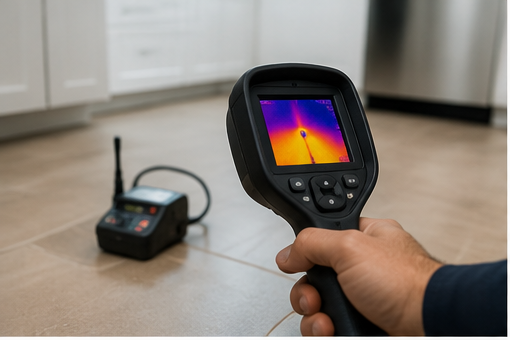
An infrared camera reads the temperature difference through the slab. Very effective on hot water leaks, less so on cold.
Sections of the system are isolated and pressure tested to prove which line is losing water before anyone starts listening for it.
If a contractor wants to open concrete without locating the leak first, stop. Cutting a slab to go looking is how a manageable repair becomes an expensive one.
The Repair
Once the leak is located there is a genuine choice to make, and it is worth understanding before someone presents you with one option as if it were the only one.
| Method | Makes sense when | The downside |
|---|---|---|
| Break through the slab | The leak is in an accessible spot, the rest of the pipe is sound, and the floor covering there can be replaced easily | Your floor comes up. Concrete, dust and a repair patch you will see if the covering is tile or polished concrete |
| Tunnel underneath | The leak is under finished flooring you do not want to lose, or under a kitchen island or built in cabinetry | More expensive and slower. Excavation outside and a tunnel under the foundation, which needs backfilling properly |
| Reroute the line | The pipe is old, this is not the first leak, or the leak is somewhere awkward to reach | New pipe runs through walls or the attic rather than under the slab. Some drywall work, but the old section is abandoned for good |
| Full repipe | Repeated leaks, galvanized or polybutylene pipe, or a system at the end of its life | The biggest job and the biggest bill, but it ends the problem rather than postponing it |
If this is your second slab leak, ask directly whether a reroute or repipe makes more sense than another spot repair. Fixing leaks one at a time on failing pipe is the most expensive path there is.
Local Context
Slab leaks are not evenly distributed across the country. Three local factors stack up here, and understanding them explains both the frequency and the pattern.
Homes built here since the 1960s overwhelmingly sit on concrete slab with the supply lines cast underneath. Pier and beam construction, where a leak is visible and reachable, is the exception rather than the rule.
Our soil shrinks hard through a dry Texas summer and swells again when the rain finally arrives. That cycle puts steady mechanical stress on pipe joints under and around the slab, year after year.
The mineral load in Wichita Falls water is hard on copper over decades. Combined with soil movement outside the pipe, it shortens the life of supply lines that are already difficult to reach.
New leaks often surface shortly after a long dry spell breaks, when the soil swells rapidly after months of shrinkage. If you are going to see one, late summer into autumn is when.
Homes from the 1960s through the 1980s with original copper under the slab are the most common candidates. Newer builds with modern materials fare better, though they are not immune.
Consistent watering around the perimeter through summer keeps the soil moisture stable and reduces the shrink and swell cycle. It is cheap, it is boring, and it prevents real money in repairs.
Questions
Start with the meter test. Turn off every fixture and appliance that uses water, including the ice maker and any irrigation, then watch the meter's leak indicator dial. If it moves, water is escaping somewhere in the system. Combine that with a warm spot on the floor, the sound of running water with everything off, or a bill that jumped without explanation, and a slab leak becomes the likely answer. The test takes fifteen minutes and costs nothing.
Two reasons stack up. Most homes built here since the 1960s sit on a concrete slab with the water supply lines running underneath it, so any failure is buried by design. On top of that, our clay soil shrinks through a dry summer and swells when the rain returns, which puts constant mechanical stress on those buried joints. Add hard water working on copper from the inside and you have the conditions for it.
Yes, and this is the reason not to wait. Water escaping under the slab either washes out the soil supporting it or, in clay, causes localised swelling. Either way the slab stops being evenly supported, and that shows up as new cracks in drywall, doors that stick and tile grout splitting. Foundation repair costs several times what the plumbing repair would have. A slab leak is one of the few plumbing problems where delay reliably multiplies the bill.
Not necessarily. There are three usual approaches: breaking through the slab directly above the leak, tunnelling under the foundation from outside, or rerouting the affected line through walls and the attic and abandoning the section under the concrete. Breaking through is fastest and cheapest but your floor comes up. Tunnelling protects the floor but costs more. Rerouting makes most sense when the pipe is old or this is not the first leak.
A single leak in otherwise sound pipe is a repair, straightforwardly. But a second or third leak in the same system is the pipe telling you it has reached the end of its life. At that point each individual repair is buying you a few months, and a reroute or full repipe is usually cheaper over any reasonable time horizon. If a plumber recommends a repipe, ask them to explain what they saw that led there, and expect a clear answer.
It varies more than people expect, so do not assume either way. Many Texas homeowner policies cover the damage caused by the escaping water and the cost of accessing the pipe, including breaking and repairing the concrete, but exclude the pipe repair itself. Some exclude slab leaks entirely. Call your insurer before work starts and ask specifically what is covered, because the answer sometimes changes which repair method makes financial sense.
Locating the leak is usually a few hours. A straightforward break through repair is often a same day job once located, though the concrete patch needs time to cure before flooring goes back. Tunnelling adds a day or more depending on the distance. A reroute is typically one to two days plus drywall repair afterwards. Any plumber should give you a realistic sequence before starting, not just a total.
The leak does not stabilise. Pressurised water keeps eroding the opening, so the flow increases over time, your bill keeps climbing and the soil under the slab keeps moving. What starts as an inconvenient repair becomes a foundation problem, and foundation work is a different order of expense entirely. Of all the plumbing problems on this site, this is the one where waiting costs the most.
Related
Acoustic and thermal detection to find the leak before anything gets opened up.
Galvanized and polybutylene replaced in PEX, fixed price and a written schedule.
Burst pipes, sewer backups and water heater failures, 24 hours a day.
A leak under concrete does not stay the same size. The sooner it is located, the smaller the repair and the less of your floor comes up. Slab leak repair Wichita Falls, TX requests are taken around the clock, seven days a week.