
Signs of a hidden leak
A water bill that jumped, a warm spot on the floor, the sound of running water with taps off, or a meter that keeps ticking.
Requests taken 24 hours a day
Wichita Falls, Texas
Need Leak Detection Wichita Falls, TX you can count on? Paying for water you never see? Tell us what the meter is doing and we will connect you with a licensed plumber who can pinpoint the leak before anything gets opened up.
No forms, one call and you are connected
Available 24/7 in Wichita Falls
(940) 308-0202 📞 Call NowCalls are answered around the clock and may be recorded for quality and routing. Standard call rates apply.
Quick Answer
The leak detection Wichita Falls, TX homeowners rely on uses non-invasive tools, acoustic sensors, thermal imaging, and pressure testing, to pinpoint a hidden leak before any wall, floor, or slab is opened. It is the step that separates a small targeted repair from tearing out the wrong wall. Common culprits here are slab supply lines, hose bibs, and aging galvanized pipe. Verify the plumber's license free at the Texas State Board of Plumbing Examiners. To find a hidden leak, call (940) 308-0202.
Related reading: Why your water bill is suddenly high
A water bill that jumped, a warm spot on the floor, the sound of running water with taps off, or a meter that keeps ticking.
Shut off every fixture and watch the meter dial. If it still moves, water is escaping somewhere in the system.
Acoustic and thermal detection finds the exact spot, so only the leak gets opened, not a guessed section of wall or slab.
Why This Is a Service in Its Own Right
Repairing a leak is usually straightforward once you know exactly where it is. Almost all of the cost, disruption and risk in hidden leak work comes from the finding, not the fixing.
That is why proper detection is worth paying for as its own step. A plumber who starts opening walls to go looking is charging you for the search in drywall, tile and concrete rather than in equipment time, and that is a far more expensive way to buy the same information.
Do This First, It Is Free
Turn off every tap, appliance, ice maker and irrigation zone. Find the meter, usually in a box near the street. Watch the small leak indicator dial. If it turns with everything off, water is escaping.
Close the shutoff at the house and repeat. Still moving means the leak is between meter and house. Stopped means it is inside, and in a slab home that usually means under the concrete.
Put food colouring in each toilet tank and wait twenty minutes without flushing. Colour appearing in the bowl means a leaking flapper, which is a cheap fix and a surprisingly common cause of a high bill.
The Equipment
No single method works on every leak. A plumber doing this properly uses two or three in combination to narrow down and then confirm.
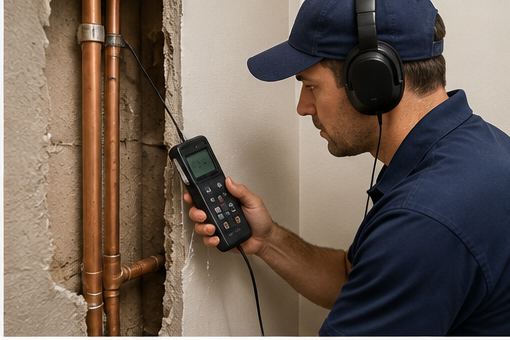
Amplified ground microphones pick up the hiss of pressurised water escaping and trace it to its loudest point. The workhorse method for slab and buried line leaks, and effective through concrete.
An infrared camera reads temperature differences through floors and walls. Excellent on hot water lines, where escaping water heats the surface above it. Less useful on cold lines.
Sections of the system are isolated and pressurised to prove which line is losing water before anyone starts listening. Turns a whole house search into a search of one run.
Locating equipment maps where the pipe actually runs under the slab or yard, which is often not where the drawings say. Essential before any excavation.
For drain and sewer leaks rather than supply. A camera in the line shows cracks, offsets and root intrusion directly, with distance measured from the cleanout.
Meters that read moisture content in flooring, drywall and subfloor. Useful for defining how far water has spread, which matters for both repair scope and insurance.
Where They Hide
Hidden leaks are not random either. In this housing stock they concentrate in a handful of places.
Supply lines cast into or beneath the concrete, in almost every home built here since the 1960s.
Tells: a warm patch on the floor, water audible with everything off, a bill that jumped. The most common hidden leak location in this city.
The service line running underground from the street to the building.
Tells: the meter keeps moving even with the house shutoff closed, and often a soft or unusually green strip in the yard along the run.
Pipe run through outside walls, which is also where freeze damage concentrates in North Texas.
Tells: staining or bubbling paint low on a wall, a musty smell, or a section of skirting that stays damp.
The single most common freeze failure point here, and easy to overlook because the water goes straight into the ground.
Tells: a permanently damp patch near the tap, or a bib that drips inside the wall rather than outside after a freeze.
A valve that weeps or a cracked line, running only when the system cycles.
Tells: a high bill with a meter test that passes, because the leak only exists while the system runs. Isolate the irrigation and compare.
Connections, the relief valve discharge line and the pan drain, often in a closet where nobody looks.
Tells: a musty smell in a hall closet, or staining on the floor at the edge of the unit rather than beneath it.
Questions
Turn off every fixture and appliance that uses water, including the ice maker and any irrigation zones, then find the meter and watch the small leak indicator dial. If it moves at all with everything off, water is escaping somewhere. For confirmation, take a reading, wait thirty minutes without using any water, and read again. Any change proves a leak. This takes fifteen minutes, costs nothing, and turns a suspicion into a fact worth acting on.
When the leak is hidden, yes, clearly. Detection costs a fraction of opening the wrong wall, cutting the wrong section of slab or replacing a run of pipe that turned out not to be the problem. The only situation where it is unnecessary is a leak that is already visible and reachable. If a plumber proposes exploratory demolition instead of locating first, ask why, and be ready to get a second opinion.
Acoustic listening equipment picks up the sound of pressurised water escaping and traces it to its loudest point, working even through concrete. Thermal imaging reads temperature differences through floors and walls, which is very effective on hot water lines. Pressure isolation proves which section of the system is losing water before anyone starts listening, and line tracing maps where the pipe actually runs. Good practice uses several in combination and confirms with a second method before opening anything.
Locating it, yes. Detection is non destructive by design and that is precisely its value. Repairing it may still mean opening a wall or a section of slab, but you will be opening one specific place that has been confirmed, rather than searching. In some cases, particularly with older pipe, the outcome of detection is a decision to reroute the line entirely and leave the failed section abandoned in place.
Look at things that run intermittently rather than constantly, because a snapshot meter test will not catch them. A toilet flapper that only leaks after a flush, an irrigation valve that weeps while the system runs, a pool auto fill, or a water softener stuck in a regeneration cycle. Each of these can add a lot over a billing period while showing nothing on a quiet afternoon. The food colouring test on every toilet is the cheapest place to start.
Pressurised supply leaks do, reliably. Water escaping through a small opening keeps eroding that opening, so the flow increases over time and your bill climbs with it. Under a slab there is a second problem: the escaping water either washes out the soil supporting the foundation or, in our clay, makes it swell locally. Either way the slab loses even support. That is how a plumbing repair becomes a foundation repair, which is a different order of expense.
It varies, and it is worth asking before booking the work rather than after. Many Texas policies cover the cost of locating and accessing a leak along with the resulting water damage, while excluding the pipe repair itself. Some cover detection specifically. A documented location and cause report is generally more useful in a claim than an invoice describing exploratory work, which is another argument for doing it properly.
Most residential leak location is a few hours, sometimes less if the symptoms already point at a specific area. Complicated cases, particularly a slab leak in a large home with several possible runs, can take longer because the plumber isolates sections methodically before listening. Expect a written or marked location at the end, with the position and depth noted, rather than a verbal indication of roughly where to dig.
Related
Warm floors and a jumped water bill. Located properly before any concrete is cut.
Galvanized and polybutylene replaced in PEX, fixed price and a written schedule.
Burst pipes, sewer backups and water heater failures, 24 hours a day.
Locating a leak properly costs a fraction of opening the wrong wall. Requests are taken around the clock, seven days a week.