
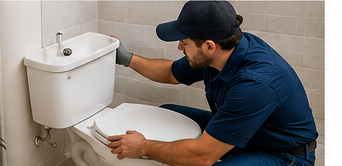
Running constantly
Almost always a worn flapper or fill valve, a cheap part that quietly runs up every water bill until replaced.
Requests taken 24 hours a day
Wichita Falls, Texas
Need Toilet Repair Wichita Falls, TX you can count on? Running constantly, blocking every week, rocking when you sit on it, or water pooling at the base? Tell us what it is doing and we will connect you with a licensed plumber nearby.
No forms, one call and you are connected
Available 24/7 in Wichita Falls
(940) 278-1884 📞 Call NowCalls are answered around the clock and may be recorded for quality and routing. Standard call rates apply.
Quick Answer
The toilet repair Wichita Falls, TX homeowners need is usually a quick, affordable fix: a running toilet is normally a flapper or fill valve, a rocking toilet means a failed wax ring or loose flange, and constant blockages point to a partial clog or a weak flush. A leak at the base needs prompt attention before it damages the subfloor. A licensed plumber diagnoses and quotes before any work. Verify the license at the Texas State Board of Plumbing Examiners. For toilet help, call (940) 278-1884.
Related reading: How to unclog a toilet
Almost always a worn flapper or fill valve, a cheap part that quietly runs up every water bill until replaced.
A failed wax ring or loose flange. Fix it fast, a base leak rots the subfloor you cannot see.
Add dye to the tank to catch a silent leak, and check the water level against the overflow tube before calling.
Reading the Symptom
Toilets are simple machines with a small number of failure points. The behaviour tells you which one, and often whether it is a part or a bigger problem.
You hear it refilling every so often with nobody using it.
Usually: a worn flapper letting water seep from tank to bowl, so the fill valve keeps topping up. Cheap part, easy fix, and worth doing quickly because it wastes a lot of water quietly.
A damp ring on the floor that keeps coming back after you dry it.
Usually: a failed wax ring, the seal between toilet and drain flange. Water escapes at every flush into the subfloor. Needs the toilet lifting and resealing, and it should not be left.
Noticeable movement, sometimes with a creak.
Usually: loose closet bolts, an uneven floor, or a damaged flange underneath. Rocking breaks the wax seal, so this becomes a leak if ignored. Do not just crank the bolts tighter, that cracks porcelain.
Needs two flushes, or leaves waste behind regularly.
Usually: low tank water level, a flapper closing too early, or blocked rim jets under the bowl rim. In hard water areas like ours, scaled rim jets are a genuinely common cause that gets misdiagnosed as a worn out toilet.
Blocking weekly despite normal use.
Usually: not the toilet at all. A partial blockage in the branch line, a vent problem, or an object lodged in the trap. If a plunger is part of your weekly routine, the cause is downstream.
Bubbling when another fixture drains, or the bowl level rising and falling.
Usually: a venting problem or a partial main line blockage. This one is worth acting on, because it can be the early warning before a sewer backup.
Try This First
Both take a few minutes, cost nothing, and either solve the problem or tell the plumber something useful.
Local Factor
Wichita Falls water carries a heavy mineral load, and toilet components sit in that water permanently. Fill valves scale up and stick, flappers stiffen and stop sealing, and the small rim jets under the bowl gradually block.
This is why toilet parts here often need replacing sooner than the packaging suggests, and why a toilet that flushes weakly is frequently scaled rather than worn out.
Regardless of packaging. They do not break down like paper and they snag on anything rough in the line. A growing share of repeat blockages start here.
Questions
Almost always the flapper or the fill valve. A worn or scaled flapper lets water seep from the tank into the bowl, the level drops, and the fill valve keeps topping it up. Confirm it with the food colouring test: a few drops in the tank, wait twenty minutes without flushing, and if colour appears in the bowl the flapper is the culprit. Both parts are inexpensive. In our hard water they wear faster than the packaging suggests.
More than people expect, because it runs continuously and almost silently. A steadily leaking flapper wastes a substantial volume every single day, and it is one of the most common explanations for a water bill that has crept up with no change in habits. If your bill has risen and the meter test does not show a large leak, check every toilet in the house before assuming anything more serious.
Usually a failed wax ring, which is the seal between the bottom of the toilet and the drain flange in the floor. Small amounts of water escape at every flush and work into the subfloor, where you cannot see what is happening. Repair means lifting the toilet, replacing the seal and checking the flange underneath is sound. It is not an expensive job, but it is worth doing promptly because the damage accumulates out of sight.
Loose closet bolts, an uneven floor, or a damaged flange underneath. It matters more than it seems, because rocking breaks the wax seal and turns a stability problem into a leak. The instinct is to tighten the bolts, but overtightening cracks the porcelain and turns a small job into a replacement. The right approach is lifting it to see whether the flange is intact and shimming properly if the floor is out.
Valves, flappers and seals are inexpensive and worth fixing on a fundamentally sound toilet, even an old one. Replacement makes sense in three cases: cracked porcelain, which cannot be repaired reliably, a failed flange that needs significant work anyway, or a very old high volume model where a modern unit uses considerably less water per flush and pays for itself over time. Weak flushing on its own is usually scale rather than age, so check that before replacing.
No, and treating it as normal is how people end up plunging weekly for years. Repeated blockages in one toilet point at something beyond the pan itself: a partial blockage in the branch line, a venting problem, or occasionally an object lodged in the trap that catches everything passing. If it blocks more than very occasionally, the cause is downstream and it needs looking at properly rather than clearing again.
Many people do, and on a straightforward swap with a sound flange it is a manageable job. The parts that catch people out are the flange condition, which you only see once the old toilet is up, and getting the wax ring seated correctly first time since it does not tolerate a second attempt. If the flange is damaged, sits below floor level after new flooring, or the supply shutoff will not close, it becomes a plumber's job quickly.
Wipes of any kind regardless of what the packet claims, cotton products, dental floss, paper towel, and anything described as disposable that is not toilet paper. Wipes are the biggest single offender because they do not break down and they catch on any root, offset or rough joint in the line. In older Wichita Falls neighbourhoods with clay sewer pipe there is plenty for them to catch on.
Related
Slow tubs, blocked kitchen lines and sewer clogs, cleared and camera checked.
Dripping taps, tub valves, hose bibs and shower cartridges.
Burst pipes, sewer backups and water heater failures, 24 hours a day.
A running toilet quietly adds to every bill until it is fixed. A leaking one is doing damage you cannot see yet.